🚀 Why Product and Service Analysis Is Essential Before Launching Any Business
Launching a product or service without conducting a proper Product and Service Analysis is one of the biggest reasons businesses fail. Many entrepreneurs invest significant time, money, and resources based on assumptions rather than verified market research and business intelligence.
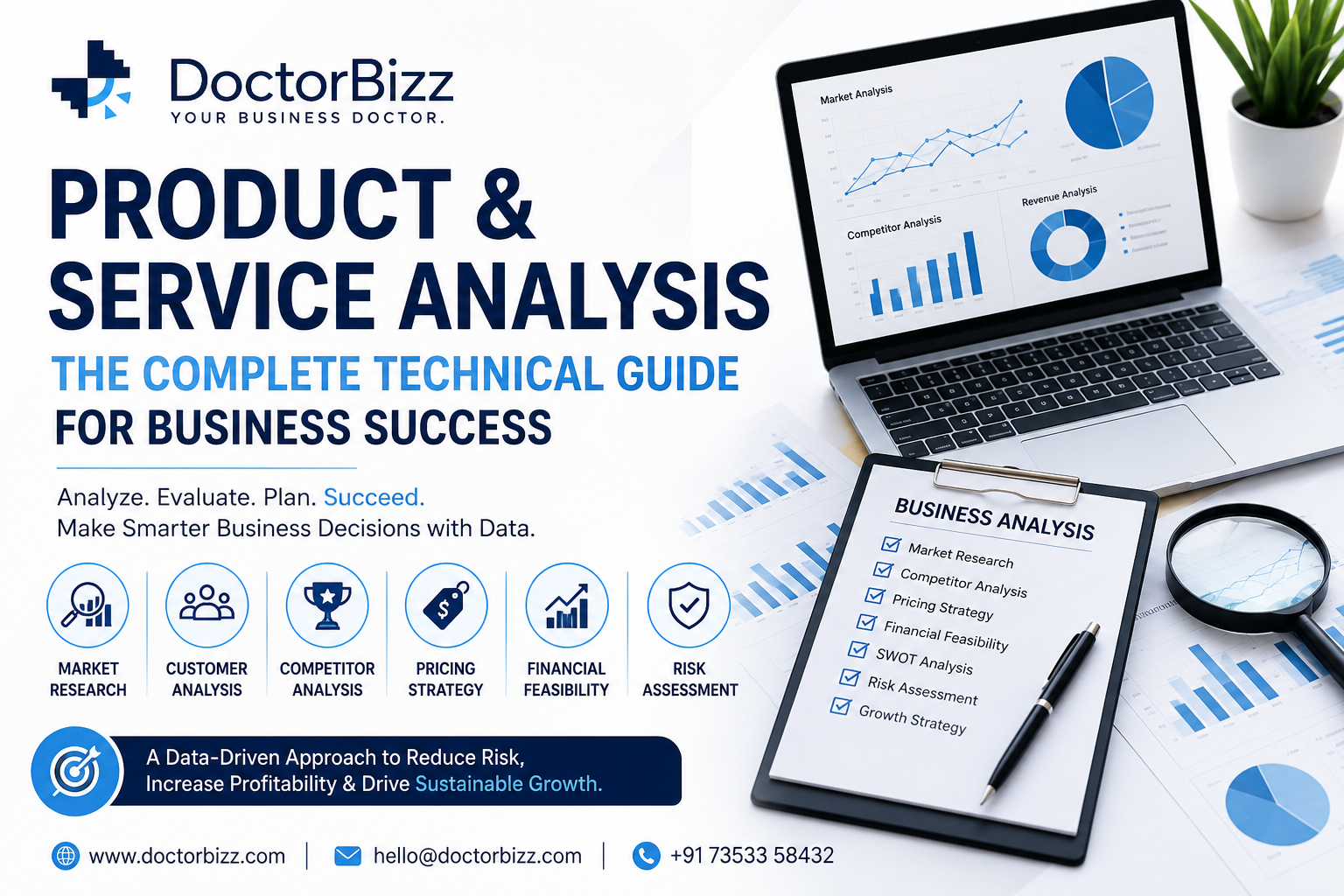
A professional Product and Service Analysis is a comprehensive evaluation that helps businesses understand whether a product or service has real market potential before investing. It combines market research, customer insights, competitor benchmarking, pricing strategy, financial feasibility, operational planning, and risk assessment into one structured framework.
Whether you are a startup founder, entrepreneur, manufacturer, wholesaler, retailer, service provider, or investor, a detailed Product and Service Analysis helps reduce uncertainty, identify hidden risks, improve profitability, and increase the chances of long-term business success.
At DoctorBizz, we analyze every business idea like a medical diagnosis. Instead of relying on assumptions, we use data-driven research and proven business frameworks to identify opportunities, uncover weaknesses, and recommend strategies that support sustainable growth.
📊 1. Market Demand Analysis
Every successful business starts with one important question:
Do customers actually want this product or service?
Market Demand Analysis answers this question by evaluating the current and future demand for a product or service. It prevents businesses from investing in ideas that have little or no market potential.
A complete Market Demand Analysis includes:
• 📈 Total Addressable Market (TAM)
• 📊 Serviceable Available Market (SAM)
• 🎯 Serviceable Obtainable Market (SOM)
• 🔍 Search Volume Analysis
• 📅 Seasonal Demand Forecasting
• 👥 Consumer Buying Behaviour
• 🛒 Purchase Frequency Analysis
• 📉 Market Growth Rate
• 🌍 Geographic Demand Distribution
• 📈 Industry Growth Trends
• 💡 Emerging Consumer Trends
• 🔄 Demand Sustainability
A strong understanding of customer demand significantly reduces business risk and improves investment decisions.
🎯 2. Target Audience Analysis
Even an excellent product can fail if it targets the wrong customers.
Target Audience Analysis identifies the people most likely to purchase your product or service. It helps businesses create better marketing campaigns, pricing strategies, and customer experiences.
Key areas include:
• 👥 Customer Persona Development
• 🎂 Age and Demographic Analysis
• 🌍 Geographic Segmentation
• 💼 Occupation and Income Analysis
• ❤️ Lifestyle and Interests
• 🧠 Psychographic Analysis
• 🛍 Buying Behaviour
• 😟 Customer Pain Points
• 🎯 Purchase Intent
• 🛒 Customer Decision Journey
• 📱 Preferred Communication Channels
• 💬 Customer Expectations
Understanding your audience allows businesses to create products and services that solve real customer problems.
🏆 3. Competitor Analysis
No business operates without competition.
Competitor Analysis identifies who your competitors are, what they offer, how they price their products, and where opportunities exist to differentiate your business.
A comprehensive Competitor Analysis evaluates:
• 🏢 Direct Competitors
• 🔄 Indirect Competitors
• 🥇 Industry Leaders
• 💰 Competitor Pricing Models
• 📦 Product Features
• 🌟 Brand Positioning
• 📈 Market Share
• ⭐ Customer Reviews
• 📣 Marketing Strategies
• 📱 Social Media Presence
• 💻 Website Performance
• 💎 Unique Selling Propositions (USPs)
Studying competitors helps businesses discover gaps in the market and build stronger competitive advantages.
💰 4. Pricing Strategy Analysis
Pricing influences both customer perception and business profitability.
A well-designed pricing strategy ensures that a product remains competitive while generating sustainable profits.
Professional Pricing Strategy Analysis includes:
• 💵 Cost-Plus Pricing
• 💎 Value-Based Pricing
• ⚔️ Competitive Pricing
• 🚀 Penetration Pricing
• 👑 Premium Pricing
• 📉 Discount Pricing
• 🎁 Bundle Pricing
• 🔄 Subscription Pricing
• 🧠 Psychological Pricing
• 📊 Profit Margin Analysis
• 💹 Break-even Pricing
• 📈 Revenue Optimization
The right pricing strategy increases customer acquisition while protecting profit margins.
📈 5. Financial Feasibility Analysis
Before launching any business, entrepreneurs must determine whether the idea is financially viable.
Financial Feasibility Analysis evaluates expected costs, revenue, profitability, and investment requirements.
Important financial metrics include:
• 💰 Revenue Forecasting
• 📊 Gross Profit Margin
• 📉 Net Profit Margin
• ⚖️ Break-even Analysis
• 📈 Return on Investment (ROI)
• 💵 Customer Acquisition Cost (CAC)
• ❤️ Customer Lifetime Value (CLV)
• 💼 Working Capital Requirements
• 💳 Cash Flow Forecasting
• 📑 Operating Expenses
• 📈 Profitability Analysis
• 💹 Investment Recovery Period
This analysis helps businesses avoid costly financial mistakes before launching.
⚙️ 6. Operational Feasibility Analysis
Operational Feasibility determines whether a business can deliver its product or service efficiently.
Even a profitable business idea can fail if operations are poorly managed.
Key operational factors include:
• 🏭 Manufacturing Process
• 📦 Inventory Management
• 🚚 Supply Chain Planning
• 🤝 Vendor Management
• 📋 Standard Operating Procedures (SOPs)
• ⚙️ Production Capacity
• 🤖 Process Automation
• 👨💼 Workforce Requirements
• 📦 Procurement Management
• 🛡️ Quality Control Systems
• ⏱️ Delivery Timelines
• 📈 Operational Efficiency
Efficient operations reduce costs, improve customer satisfaction, and support long-term growth.
🚚 7. Logistics and Supply Chain Analysis
Logistics directly impacts customer satisfaction and profitability.
A delayed delivery or inefficient supply chain can damage a business’s reputation and increase operational costs.
A complete Logistics and Supply Chain Analysis includes:
• 🚛 Warehouse Management
• 📦 Inventory Turnover
• 🚚 Transportation Planning
• 📍 Distribution Network
• 📦 Packaging Standards
• ⏳ Lead Time Analysis
• 🔄 Reverse Logistics
• 🤝 Supplier Performance
• 🌍 Distribution Coverage
• 📊 Fulfilment Efficiency
• 💰 Logistics Cost Analysis
• 📈 Supply Chain Risk Assessment
A well-managed logistics system improves operational efficiency while reducing unnecessary costs.