
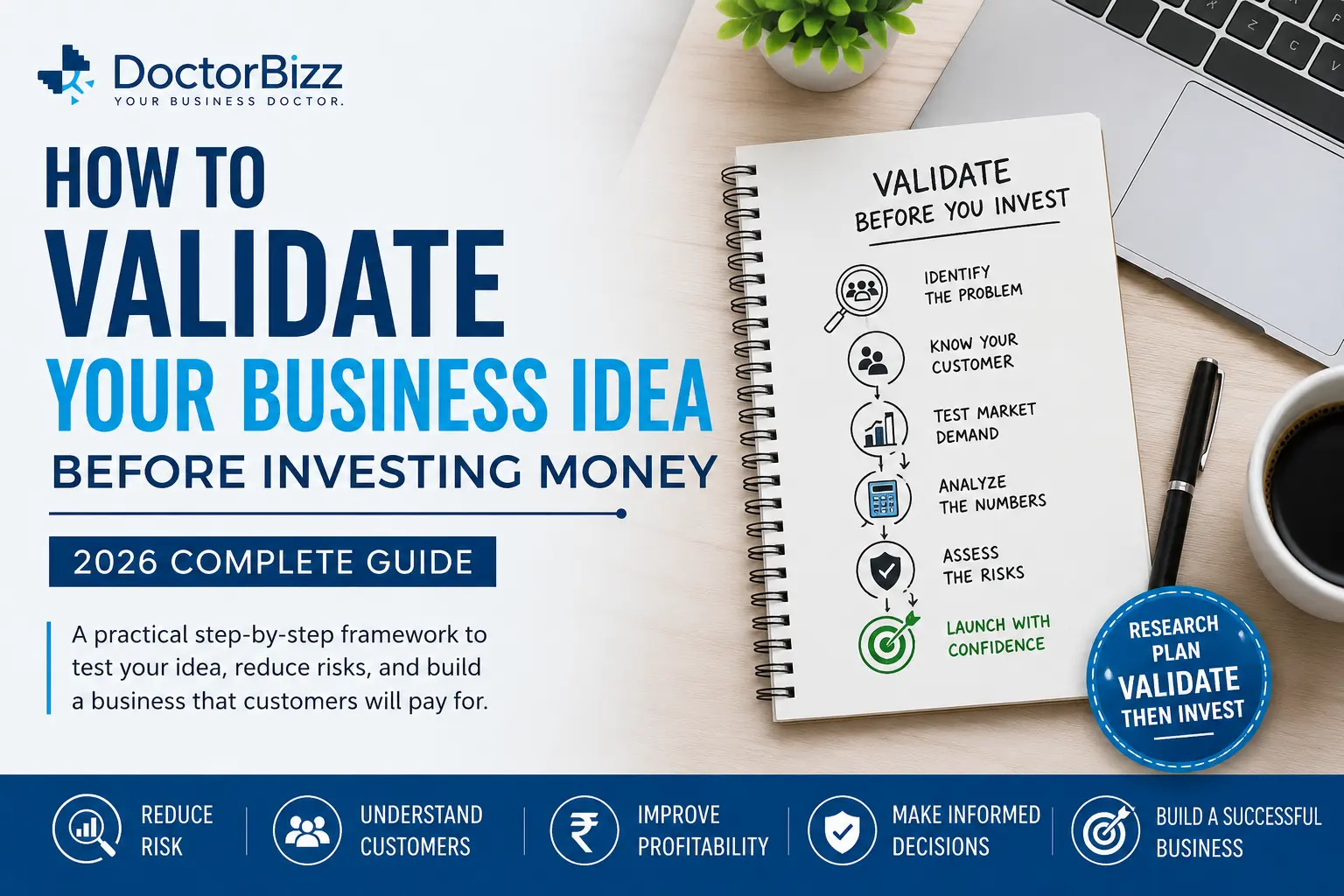
How to Validate a Business Idea Before Investing Money (2026 Complete Guide)
Starting a business is exciting. Whether you’re planning to launch a retail store, an online business, a manufacturing unit, or a service-based company, every entrepreneur dreams of turning their idea into a successful business.
Unfortunately, many businesses fail before they complete their first year—not because the founders lacked passion, but because they invested in ideas that were never validated.
One of the biggest mistakes entrepreneurs make is assuming that if they think an idea is great, customers will automatically buy it. In reality, the market—not your opinion—decides whether your business succeeds.
Before investing your savings, quitting your job, purchasing inventory, or renting office space, you must validate your business idea.
This guide will help you understand how to evaluate your idea, identify potential risks, and make informed decisions before investing your hard-earned money.
What is Business Idea Validation?
Business idea validation is the process of determining whether your idea has genuine market demand before making a significant investment.
Validation answers important questions like:
- Does the problem actually exist?
- Are customers willing to pay for a solution?
- Is the market large enough?
- Can the business become profitable?
- What risks should you prepare for?
Business validation isn’t about proving your idea is perfect. It’s about gathering evidence that your idea can become a sustainable business.
Why Business Validation Matters
Every successful business starts with understanding customer needs—not by guessing them.
Validating your business idea helps you:
- Reduce financial risk.
- Understand customer expectations.
- Identify your competitors.
- Improve your product or service.
- Save time and money.
- Build confidence before launching.
Launching a business without validation is like constructing a building without checking the strength of its foundation.
Why Most Business Ideas Fail
Many businesses fail because entrepreneurs make decisions based on emotions instead of facts.
Some common reasons include:
- No customer demand.
- Poor market research.
- Wrong pricing strategy.
- Weak financial planning.
- High operational costs.
- Strong competition.
- Lack of differentiation.
- Poor understanding of customer needs.
Most failures are preventable if entrepreneurs invest time in research before investing money.
Step 1: Define the Problem Clearly
Every successful business solves a problem.
Don’t begin with your product.
Begin with your customer’s pain point.
Instead of saying:
“I want to sell organic snacks.”
Ask yourself:
“What problem am I solving for my customers?”
Maybe your customers want healthier snacks with no preservatives.
Maybe they need affordable healthy options for children.
Maybe working professionals need convenient and nutritious snacks.
The better you understand the problem, the stronger your business foundation becomes.
Step 2: Identify Your Target Customer
One of the biggest mistakes entrepreneurs make is believing that everyone is their customer.
In reality, businesses succeed when they understand exactly who they serve.
Define your ideal customer based on:
- Age
- Gender
- Occupation
- Income
- Location
- Lifestyle
- Buying habits
- Challenges
- Budget
The clearer your customer profile, the easier it becomes to create products, pricing, and marketing strategies that work.
Step 3: Research Your Competitors
Competition is not something to fear.
Competition proves that customers already exist.
Study your competitors carefully.
Analyze:
- Products
- Pricing
- Customer reviews
- Delivery experience
- Marketing
- Branding
- Customer complaints
Ask yourself:
- What are they doing well?
- Where are customers unhappy?
- Can you offer something better?
Success often comes from improving an existing solution rather than inventing a completely new one.
Step 4: Validate Market Demand
Never assume customers will buy your product.
Instead, test demand before investing.
You can:
- Create a simple landing page.
- Run a small Meta Ads campaign.
- Collect enquiries.
- Accept pre-orders.
- Conduct customer interviews.
- Create a waiting list.
- Offer prototypes.
If people are willing to show genuine interest before your business launches, it’s a strong indication that demand exists.
Step 5: Study the Numbers
Many entrepreneurs focus only on sales.
Successful entrepreneurs focus on profit.
Before launching, calculate your expected costs.
| Expense | Example |
|---|---|
| Product Cost | ₹450 |
| Packaging | ₹40 |
| Shipping | ₹80 |
| Marketing | ₹150 |
| Miscellaneous | ₹30 |
| Total Cost | ₹750 |
| Selling Price | ₹1,000 |
| Expected Profit | ₹250 |
Understanding your numbers early helps you avoid unpleasant surprises after launch.
Step 6: Evaluate Business Risks
Every business has risks.
Ignoring them won’t make them disappear.
Common risks include:
- Supplier dependency
- Seasonal demand
- Government regulations
- Cash flow shortages
- Strong competitors
- Price wars
- Changing customer preferences
Prepare solutions before these risks become problems.
DoctorBizz Diagnosis
Many entrepreneurs ask their friends and relatives whether their business idea is good.
Unfortunately, friends don’t buy businesses.
Customers do.
A compliment doesn’t validate a business.
A paying customer does.
Always rely on research, customer feedback, and business analysis rather than personal opinions.
Business Validation Checklist
Before investing your money, answer these questions honestly.
✔ What problem am I solving?
✔ Who is my target customer?
✔ Is there enough market demand?
✔ Who are my competitors?
✔ What makes my business different?
✔ Can my pricing generate profit?
✔ Do I understand my costs?
✔ What are the biggest risks?
✔ How will I attract customers?
✔ Why should customers choose me over competitors?
If you cannot confidently answer these questions, your business idea may need further validation.
Common Mistakes Entrepreneurs Make
Avoid these common mistakes:
- Falling in love with the idea instead of solving customer problems.
- Ignoring competitor research.
- Spending too much before testing demand.
- Assuming everyone is a customer.
- Pricing emotionally instead of strategically.
- Depending only on family feedback.
- Skipping financial planning.
Action Plan Before You Launch
Before investing money:
- Identify the problem.
- Understand your target audience.
- Research competitors.
- Test demand.
- Calculate profitability.
- Assess risks.
- Improve your business model.
- Validate with real customers.
- Create a marketing strategy.
- Launch with confidence.
Conclusion
A successful business is built on research—not assumptions.
Validating your business idea gives you clarity, reduces unnecessary risks, and helps you make informed decisions before investing your time and money.
Whether you’re launching your first startup or expanding an existing business, taking the time to validate your idea can significantly improve your chances of long-term success.
Remember, the goal isn’t to prove your idea is perfect—it’s to ensure your business solves a real problem for real customers in a profitable and sustainable way.
DoctorBizz Expert Insight
Many entrepreneurs spend months perfecting a product before asking a simple question:
“Will people actually buy it?”
At DoctorBizz, we believe every successful business begins with evidence—not assumptions.
Our Business Feasibility Scan evaluates your business idea across 20+ critical factors, including market demand, competition, customer fit, profitability, operational feasibility, pricing strategy, and growth potential.
Before investing lakhs into your dream, invest a little time in understanding whether your business is truly ready for the market.
Make informed decisions. Build with confidence. Grow with clarity.
Frequently Asked Questions
What is business idea validation?
Business idea validation is the process of confirming that customers need your product or service and are willing to pay for it before you invest significant time or money.
Why should I validate my business idea?
Validation reduces risk, improves decision-making, helps you understand your customers, and increases your chances of building a profitable business.
How long should business validation take?
Depending on the business type, validation may take a few days to several weeks. The goal is to collect enough reliable information before making major investments.
Is competition a bad sign?
No. Competition usually indicates that a market already exists. The key is to understand how your business can offer unique value.
Can a unique business idea still fail?
Yes. Even innovative ideas can fail if there is no customer demand, poor execution, or an unsustainable business model.
How can DoctorBizz help?
DoctorBizz provides structured business analysis services, including the Business Feasibility Scan, to help entrepreneurs evaluate their ideas before investing and launching.
Business Success Begins With Better Decisions
The difference between successful businesses and failed businesses isn’t luck—it’s the quality of their decisions.
At DoctorBizz, we help entrepreneurs and business owners reduce uncertainty through structured business diagnostics, in-depth analysis, and practical strategic insights.
Whether you’re planning your first business, improving an existing product, or building a stronger business foundation, we’re here to help.
Choose the solution that fits your business journey.
Perfect for entrepreneurs validating a new business idea before investing.
Designed for existing businesses looking to improve performance, profitability, and growth.
Learn practical business strategies from our India-focused digital playbook for founders and sellers.